Lux GAAP vs IFRS for Funds: Presentation Differences (2026)
June 11, 2026
Financial Reporting

If you prepare financial statements for Luxembourg investment funds, you almost certainly work across both frameworks. A UCITS or SIF might report under Lux GAAP while the parent group consolidates under IFRS. A new US-based asset manager setting up a RAIF asks which standard to use. An auditor sends comments referencing an IFRS treatment — on a fund that files under Lux GAAP.
The frameworks are not wildly different, but the differences that exist tend to land exactly where errors happen: statement structure, how investments are valued, what gets disclosed, and what doesn't even appear.
This article covers five of those differences — the ones that consistently produce confusion, auditor comments, and late-night revisions.
A quick orientation: which funds use which framework?
Under Luxembourg law, most regulated investment vehicles can choose between Lux GAAP and IFRS:
UCITS (governed by the Law of 17 December 2010): Lux GAAP or IFRS
SIF (Law of 13 February 2007): Lux GAAP or IFRS
RAIF (Law of 23 July 2016): Lux GAAP or IFRS
Part II UCI funds (Law of 17 December 2010): Lux GAAP or IFRS
SICAR (Law of 15 June 2004): Lux GAAP or IFRS
SCSp / SCS: Lux GAAP, IFRS, or — where specified in the LPA — other equivalent standards (including US GAAP)
Lux GAAP itself is primarily anchored in the Law of 19 December 2002 on the accounting and annual accounts of undertakings, as amended. IFRS as adopted by the EU is directly applicable where elected.
The CSSF supervises compliance for regulated entities and its circulars set additional requirements — notably Circular CSSF 08/340 on audit reports and accounting regimes.
Difference 1: Fair value vs. historical cost — and what it does to your P&L
This is the foundational difference, and it flows through almost everything else.
Lux GAAP is built on the prudence principle and historical cost. Investments are recorded at acquisition price. Unrealised gains are not recognised. If a position drops below cost, you impair it. If it recovers, you reverse the impairment — but you never book a gain until realisation.
IFRS — specifically IFRS 9 — takes a different approach. Financial assets are classified into three categories (amortised cost, fair value through other comprehensive income, fair value through profit or loss), and most fund investments land in the third: fair value through P&L. Unrealised gains and losses hit the income statement every period.
What this means in practice: Under IFRS, a fund with a strong year of unrealised appreciation reports a significantly larger surplus than the same fund under Lux GAAP. Both are technically correct. Investors who read both sets of statements without knowing this will draw different conclusions about performance.
Where errors happen: Misclassifying Lux GAAP unrealised movements as income, or failing to split realised and unrealised gains in the income statement where disclosure is required.
Key resources:
Difference 2: Statement structure — the income statement is not the same document
Open a Lux GAAP fund annual report and an IFRS one side by side. The income statement looks different enough that you might wonder if you're reading the same type of document.
Under Lux GAAP, the typical structure for an investment fund follows a format that separates:
Investment income (dividends, interest, other income)
Operating expenses
Net investment income
Realised gains/(losses) on investments
Change in unrealised appreciation/(depreciation) — presented separately, not in the income statement, but as a movement in net assets
Under IFRS, the statement of comprehensive income combines realised and unrealised movements when assets are classified at FVTPL. There is no separate "change in unrealised appreciation" line below the income statement — it's absorbed into fair value movements in P&L.
The statement of changes in net assets is a Lux GAAP / investment fund convention. IFRS has no equivalent; movements in equity are captured in the statement of changes in equity, which looks and reads differently.
Where errors happen: Applying IFRS presentation logic to a Lux GAAP set — or vice versa — particularly when adapting templates from another entity in a group that uses the other framework.
Key resources:
Difference 3: Cash flow statement — required under IFRS, not under Lux GAAP
This one surprises people who come from an IFRS background.
Under Lux GAAP, investment funds are not required to prepare a statement of cash flows. Most don't. The annual report typically contains: balance sheet, income statement (or statement of operations), statement of changes in net assets, and notes.
Under IFRS (IAS 7), a statement of cash flows is required as part of a complete set of financial statements — no exceptions for investment funds.
What this means in practice: If a fund switches from Lux GAAP to IFRS, or if someone is preparing IFRS-compliant financials for the first time, the cash flow statement is an additional deliverable that requires its own data gathering, reconciliation, and presentation choices (direct vs. indirect method).
Where errors happen: Omitting the cash flow statement entirely in an IFRS set, or including it in a Lux GAAP set in a format inconsistent with IAS 7 (some funds include one voluntarily, but with non-compliant classification of items).
Key resources:
Difference 4: Consolidation — the investment entity exception
This is one of the most practically significant differences for fund preparers.
Under IFRS 10, an entity that qualifies as an "investment entity" is exempt from consolidating its subsidiaries. Instead, it measures its investments at fair value through profit or loss. Most Luxembourg investment funds qualify. The result: the financial statements represent the fund itself, not a consolidated group, even where the fund holds controlling interests in portfolio companies.
Under Lux GAAP, the consolidation rules are different. The standard consolidation requirements apply, though there are exemptions — including where the subsidiary's inclusion would be immaterial, or where a higher-level consolidated set is publicly available. The investment entity concept as defined under IFRS 10 does not exist in Lux GAAP in the same form.
What this means in practice: A private equity fund reporting under IFRS typically presents unconsolidated financials because of the investment entity exemption. The same fund under Lux GAAP may need to consolidate — or carefully document why an exemption applies.
Where errors happen: Assuming IFRS consolidation exemptions apply to Lux GAAP statements, or preparing Lux GAAP financials without considering whether consolidation is actually required.
Key resources:
Difference 5: Disclosure depth — notes requirements diverge significantly
Both frameworks require notes to the financial statements, but the depth and nature of what must be disclosed differ considerably.
Under Lux GAAP, disclosure requirements for investment funds are set by a combination of the Law of 19 December 2002 (for general entities) and fund-specific laws (UCITS, SIF, RAIF, etc.). For funds, ALFI guidance and market practice fill gaps where law is silent. The notes tend to be more concise — accounting policies, key assumptions, related parties, and fund-specific schedules (portfolio listing, subscriptions/redemptions, etc.).
Under IFRS, the disclosure requirements — particularly under IFRS 7 (Financial Instruments: Disclosures), IFRS 12 (Disclosure of Interests in Other Entities), and IFRS 13 (Fair Value Measurement) — are significantly more extensive. IFRS 7 alone requires quantitative disclosures on credit risk, liquidity risk, and market risk sensitivity. IFRS 13 requires a fair value hierarchy table with transfers between levels explained. These are not optional.
Where errors happen: Treating IFRS disclosure requirements as equivalent to Lux GAAP and producing notes that pass a Lux GAAP audit but would fail an IFRS review. Also common: producing IFRS-style disclosures for a Lux GAAP fund, creating unnecessary complexity and potential inconsistencies.
Key resources:
Reference resources
For the authoritative comparison documents, these are the publications most widely used in the Luxembourg fund industry:
Big Four comparison guides:
Deloitte Luxembourg: IFRS/US GAAP/Lux GAAP comparison for investment funds (PDF)
PwC Luxembourg: Handbook for annual accounts under Lux GAAP (PDF)
Regulatory and legal:
IASB standards (IFRS Foundation):
About LedgerQ
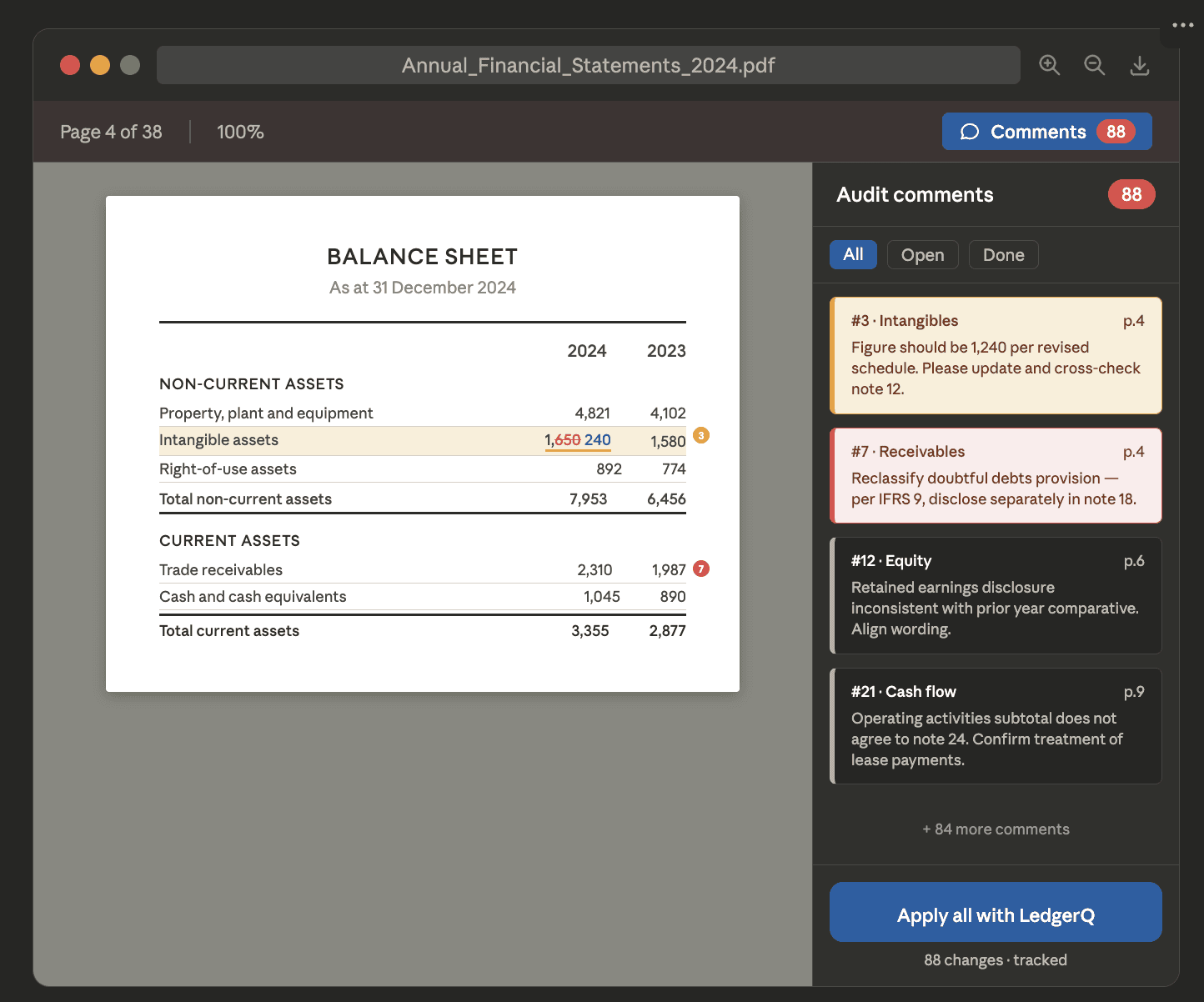
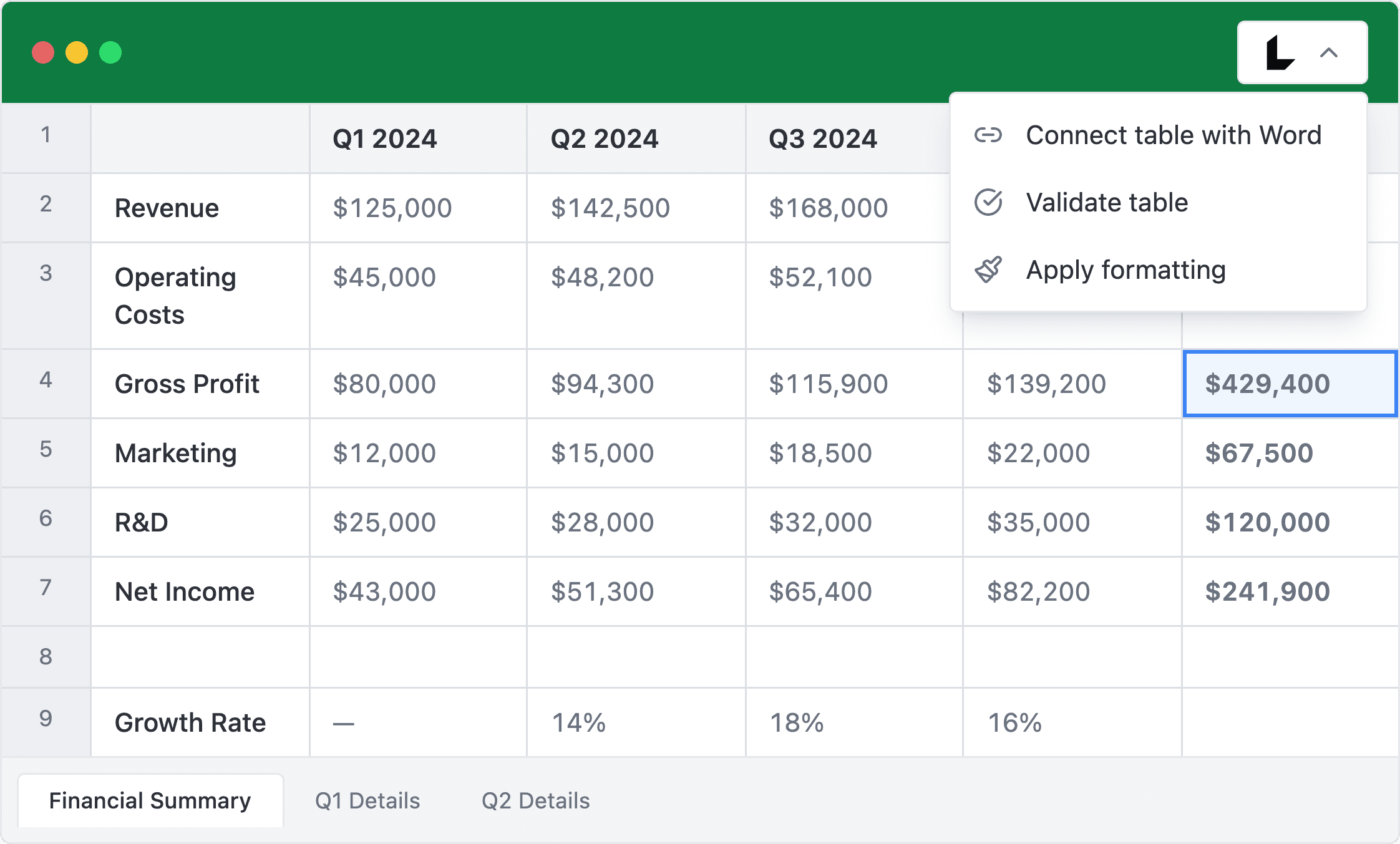
LedgerQ automates the preparation of financial statements for Luxembourg funds — including applying auditor comments, syncing Excel tables to Word, and generating primary statements.
Auditor's comments applied automatically.
LedgerQ ingests auditors’ comments directly from annotated PDFs and automatically updates the financial statements in Word, saving my team hours of manual work.